If your Anthurium has glossy leaves but almost no flowers — or the blooms fade too fast — you already have the fix in your kitchen.
This is the simple root-zone method: nestle one whole red onion into the soil of the pot, right next to the plant. No blender, no spraying, no complicated fertilizer schedule. Just onion, soil, and a little patience.
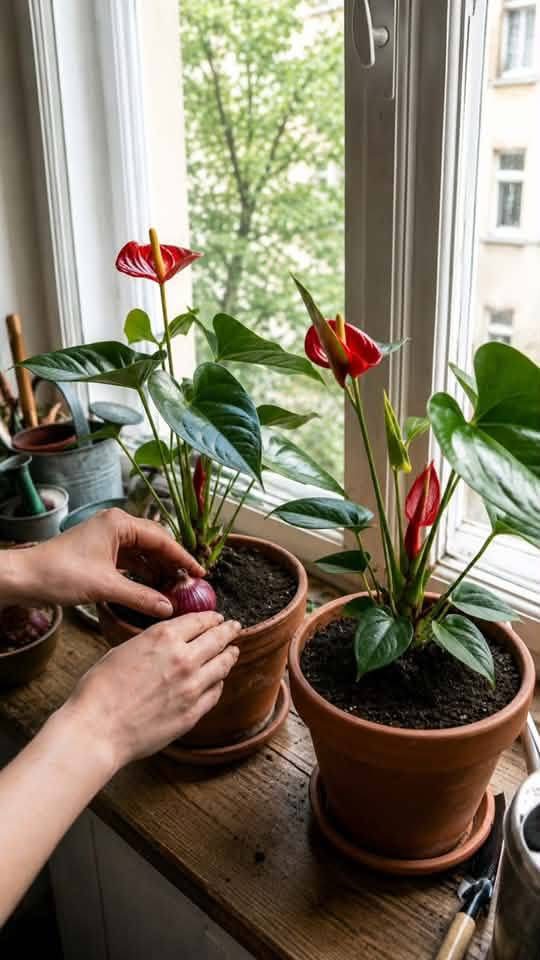
The photo you see is exactly how it looks: two terracotta pots on a sunny windowsill, heart-shaped Anthurium leaves, bright red spathes, and two hands gently pressing a purple-red onion into the dark compost.
Why You’ll Love This Method
- Uses one cheap ingredient you already have
- Takes under 2 minutes
- No mixing, straining, or spraying
- Helps keep the root zone cleaner (natural sulfur compounds)
- Encourages stronger roots and more consistent blooming
- Looks rustic and “real kitchen garden” on camera — perfect for Reels and Pinterest
What You Need
- 1 medium red onion (firm, not sprouting or soft)
- Your potted Anthurium (soil slightly moist, not soaking wet)
- A small trowel or just your fingers
- Optional: extra well-draining mix if the soil looks compacted
Optional additions
- A pinch of orchid bark or perlite on top after burying (better air around the onion)
- A thin layer of moss if you want the onion hidden from view
How to Do It (Step by Step)
- Choose the right onion
Pick a firm red onion about the size of a golf ball to a small apple. Avoid green-sprouting or mushy ones. Red onions are preferred in this visual method because the color pops in photos and the skin is slightly thicker. - Check the soil first
The compost should be lightly moist. If it is bone dry, water the plant the day before and let excess drain. Never bury an onion in soggy soil — that is the fastest way to rot. - Make a pocket next to the stem
With two fingers, push a small hole 3–4 cm deep in the soil, a few centimeters away from the main stem. Do not smash the existing roots. - Place the onion
Set the whole onion in the pocket, pointed end slightly up or on its side — either works. In the reference photo the onion sits half-visible at the soil line. - Cover lightly
Pull soil back over the onion so only the top or a sliver of skin shows. Press gently. Do not pack it hard. - Water normally
Give a light watering around the pot (not a flood on the onion itself). Let the pot drain fully. - Wait and watch
Leave the onion in place for 3–4 weeks. As it slowly breaks down it releases sulfur compounds and trace minerals into the root zone.
Aftercare (Keep It Healthy)
- Water only when the top 2–3 cm of soil feels dry.
- Keep the plant in bright, indirect light (east or west window is ideal — exactly like the photo).
- Do not fertilize with strong chemical feed for 2–3 weeks after placing the onion.
- After 3–4 weeks, gently lift the remains of the onion. If it is still firm, leave it. If it has gone soft and smelly, remove it and refresh a little surface soil.
Variations
- Slice method: Use 1 thick slice instead of the whole onion if you want faster breakdown (replace every 10–14 days).
- Onion water: Blend 1 onion with water, strain, dilute 1:4 and use as a soil drench every 2 weeks (the “solution” version of the same idea).
- Two-pot trick: Do the onion method on one plant and leave the second pot as a control so you can see the difference in new spathes.
Tips for Best Results
- Always use a pot with a drainage hole and a saucer.
- Anthuriums hate wet feet. The onion trick fails if the soil stays wet.
- Keep humidity decent (bathroom or pebble tray) — Anthuriums are tropical.
- Wipe dust off the big glossy leaves once a week so they can photosynthesize.
- If the onion starts to smell strongly of rot, take it out immediately.
How Long It Lasts / How Often to Repeat
One whole onion usually lasts 3–5 weeks before it is worth replacing. Repeat the method every 6–8 weeks during spring and summer. In winter, skip it or use a much smaller piece.
Storage
Unused onions stay in a cool, dry kitchen drawer. Do not refrigerate the one you plan to bury — cold onions sweat more when they warm up in the pot.
FAQ
Does burying a whole onion burn the roots?
Not if the soil drains well and the onion is not sitting in water. Keep a little space between onion and the thickest roots.
Will it attract fruit flies?
Sometimes, if the onion stays too wet on the surface. Bury it a bit deeper or cover the top with a thin layer of dry bark.
Can I use a yellow or white onion?
Yes. Red is just the photogenic choice and slightly richer in some compounds.
Is this a replacement for real fertilizer?
No. Think of it as a gentle root-zone booster and mild antimicrobial, not a complete feed. Continue a weak phosphorus-rich fertilizer in the growing season.
My Anthurium never flowers. Will this fix it?
It can help if the problem is weak roots or low vigor. It will not fix low light, cold drafts, or constantly wet soil.
Final Thoughts
This is one of those “too simple to work” kitchen tricks that actually looks beautiful on a wooden windowsill. Two terracotta pots, two red Anthurium spathes, and one purple onion disappearing into the soil.
Do it once, photograph the before-and-after, and you have both a healthier plant and content that people stop scrolling for.
Try it on one plant first. In a few weeks you’ll know if your Anthurium likes having a little onion neighbor.
PRINTABLE QUICK CARD
Anthurium Root-Zone Onion Method
Time: 2 minutes
Difficulty: Easy
Best season: Spring–early autumn
Repeat: Every 6–8 weeks
Ingredients
- 1 firm red onion
- 1 potted Anthurium in well-draining mix
Steps
- Soil slightly moist, not wet.
- Dig a small pocket 3–4 cm from the stem.
- Place whole onion.
- Cover lightly with soil.
- Water normally and drain.
- Remove remains after 3–5 weeks.
Light: Bright indirect
Water: When top 2–3 cm dry
Never: Soggy soil + onion