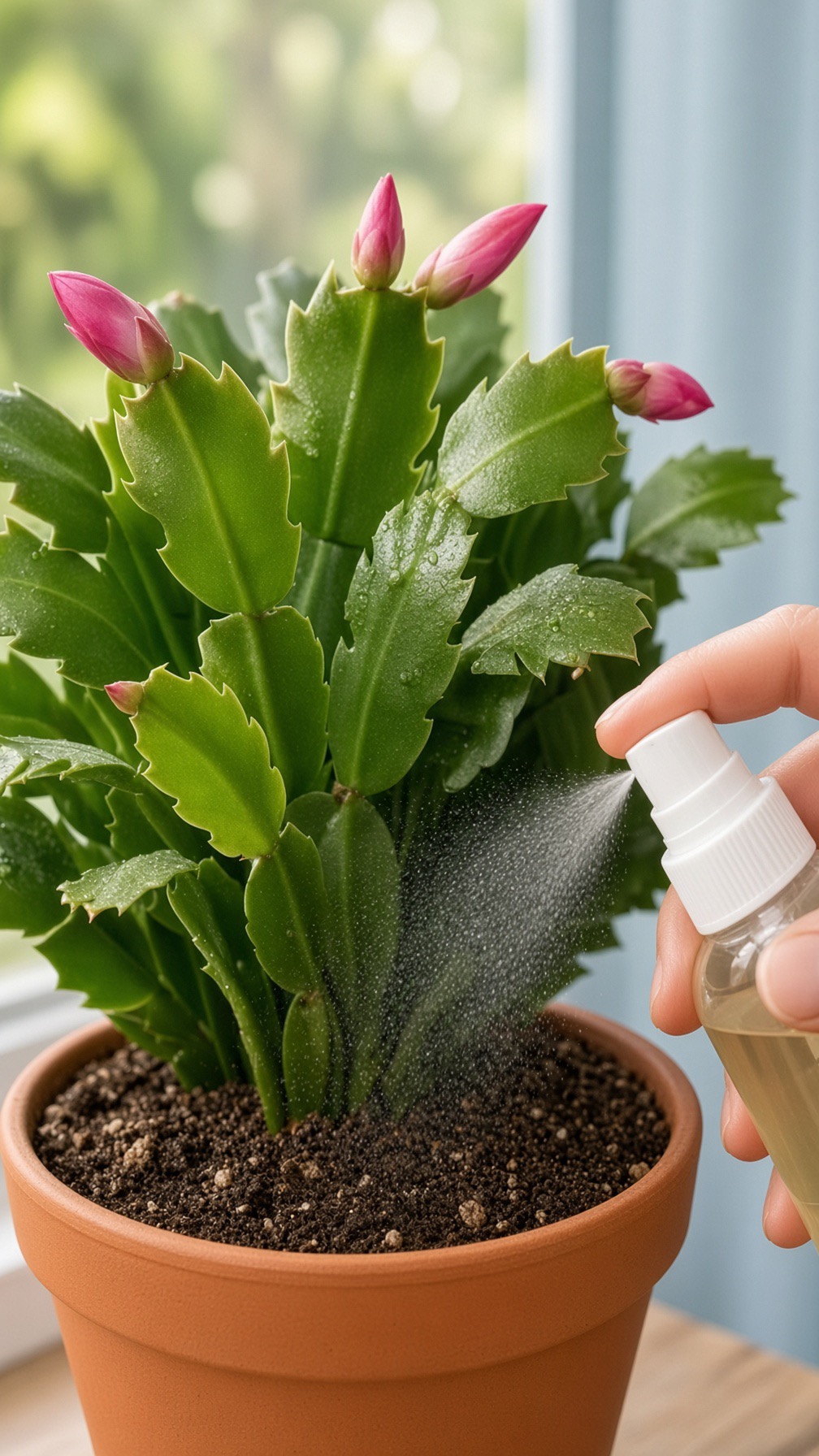
A complete year-round routine for healthy leaves, steady humidity, and holiday flowers.
Your Christmas cactus is not a desert cactus. That is the whole secret.
It is a tropical rainforest plant (Schlumbergera) that grew on trees in Brazil, not in dry sand. It wants bright
filtered light, air that is a little humid, soil that dries a bit then drinks deeply, and a cool dark stretch in
autumn if you want those pink, red, or white flowers for the holidays.
If the leaves look dull, buds drop, or the plant never flowers, the problem is almost always one of four things:
too much water in the pot, too little humidity in the air, harsh sun, or no real night-dark period before bloom
season.
This guide gives you the full year-round routine, including the misting method, so the plant stays plump,
glossy, and ready to bloom again.
Why This Care Method Works
• It treats the plant like a tropical epiphyte, not a desert cactus.
• Misting helps the air around the leaves without drowning the roots.
• You water by soil feel, not by a fixed calendar.
• Blooming is forced with darkness and cooler nights, not extra fertilizer.
• The same plant can live and flower for 20+ years with this rhythm.
What You Need
• Christmas cactus in a pot with drainage holes
• Well-draining mix (cactus or succulent mix plus a little extra perlite or orchid bark)
• Clean spray bottle with room-temperature water (filtered or rainwater if your tap is very hard)
• Optional: pebble tray, humidity tray, or a bright bathroom or kitchen spot
• Optional: balanced houseplant fertilizer at half strength (spring to early fall only)
• Optional: soil moisture meter if you overwater easily
Do not use ice cubes. Do not use oily leaf shine. Do not sit the pot in a full saucer of water.
How to Mist a Christmas Cactus the Right Way
Misting is for humidity around the plant. It is not a substitute for watering the soil.
1. Fill a clean spray bottle with room-temperature water.
2. Hold the bottle 15–25 cm from the plant.
3. Mist the leaves and the surface of the soil in a fine cloud, not a hard stream.
4. Stop when the segments look lightly beaded with droplets. Do not soak the crown until water pools.
5. Let the plant dry in bright, indirect light. Avoid misting late at night in a cold, still room.
How often to mist
• Dry heated rooms in winter: every 2–4 days while buds and flowers are present.
• Normal rooms: 1–2 times a week is enough.
• Already humid kitchen or bathroom: skip misting and use a pebble tray instead.
Misting alone will not raise whole-room humidity much. Pair it with a pebble tray if your air is very dry.
Keep the pot on the pebbles, not sitting in the water.
How to Water a Christmas Cactus (The Rule That Prevents Root Rot)
Forget “once a week.” Use the finger test.
1. Push a finger about 2–3 cm into the mix (or the top third of a deeper pot).
2. If it still feels damp, wait.
3. If it feels dry, water thoroughly until water runs out of the drainage holes.
4. Empty the saucer after 10–15 minutes. Never leave the pot standing in water.
Seasonal watering rhythm
• Spring–summer active growth: more often, often every 7–10 days in a warm home.
• Early autumn (pre-bud): let it go a little drier to help set buds.
• While budding and blooming: keep moisture even. Big swings from bone-dry to soaked cause bud drop.
• After bloom until late winter or early spring: water less, but never let the stems shrivel hard.
Overwatering signs: limp, translucent, or mushy segments, sour soil, fungus gnats.
Underwatering signs: wrinkled, limp, thin segments that plump up after a good drink.
Light, Temperature, and Placement
Best light: bright, indirect light. An east window is ideal. A south or west window needs a sheer curtain.
Direct midday sun burns the segments and turns them reddish.
Ideal temperatures
• Growing season: about 18–24°C in the day.
• To set buds: cooler nights around 10–16°C for several weeks.
• Never leave it in frost or against a freezing window pane.
Keep it away from heater vents, AC blasts, and doors that slam cold air onto the buds. Drafts and sudden
moves are a classic reason flowers fall off.
The 6–8 Week Method to Make It Bloom for Christmas
Start in early to mid October if you want flowers in December.
1. Stop fertilizing.
2. Water a little less than in summer. Soil should dry more between drinks, but stems should not collapse.
3. Give 12–14 hours of uninterrupted darkness every night for 6–8 weeks. A closet, unused room, or a box
or cover after 5–6 pm works. Even a hallway lamp can reset the clock.
4. Keep nights cool if you can (around 10–16°C).
5. During the day, give bright indirect light.
6. When you see buds, move it back to its display spot. Do not rotate or relocate it every day after that.
7. Resume more even watering. Mist lightly while buds swell.
8. Do not fertilize while it is in full bloom.
If nights stay warm (above about 21°C), give a bit more darkness. Cool nights can sometimes trigger buds
even with imperfect day length.
Month-by-Month Christmas Cactus Care
December–February
Plant is blooming or finishing bloom. Mist more often in dry heated air. Water when the top layer dries. No
fertilizer. Keep away from radiators.
March–May
Rest, then slow new growth. After flowers fade, reduce water for a few weeks. When new segments appear,
resume regular watering and start half-strength fertilizer once a month.
June–August
Active growth. Bright indirect light, consistent water, monthly weak feed. You can put it outdoors in full
shade if nights stay above 10°C. Pinch a few segments in late spring to make a bushier plant with more
bloom sites.
September–November
Stop feeding. Cooler nights. Longer dark period. This is bloom-setting season. Do not overwater. Do not
keep lights on in the same room all evening.
Soil, Pot, and Repotting
Use a mix that drains fast: cactus mix, or regular potting mix cut with perlite and a little bark. Christmas
cactus likes to be slightly snug in its pot. Repot only every 2–3 years, in spring, one size up. Always use a pot
with a hole.
If the soil stays wet for days, the mix is too heavy or the pot is too big.
Fertilizer
Feed only in the growing season (roughly April to September) with a balanced houseplant fertilizer at half
the label rate, every 3–4 weeks. Stop before the dark and cool bloom-forcing period. Extra nitrogen in
autumn can give leaves instead of flowers.
How to Propagate Christmas Cactus
Twist or cut a Y-shaped piece of 2–3 segments. Let the cut end dry for a day. Push it into barely moist mix.
Keep bright and indirect. Roots usually form in a few weeks. Water propagation works, but soil is more
reliable.
Common Problems and Fast Fixes
Buds falling off
Cause: move, draft, dry soil then flood, heat vent, or low humidity. Fix: pick one spot and leave it. Water
evenly. Mist or use a pebble tray. No more rotating the pot.
No flowers
Cause: nights too short or too bright, nights too warm, too much fertilizer, or weak light by day. Fix: 6–8
weeks of real darkness, cooler nights, and no feed.
Red or scorched segments
Cause: too much direct sun. Fix: move to filtered light.
Soft, mushy stems
Cause: root rot from wet soil. Fix: unpot, cut away black roots, repot in fresh dryish mix, water sparingly.
Wrinkled segments
Cause: thirsty plant or damaged roots. Fix: if soil is dry, water thoroughly. If soil is wet and the plant is still
wrinkled, check roots.
White cottony spots
Mealybugs. Wipe with alcohol on a cotton swab, isolate the plant, and repeat.
Tips That Actually Improve Results
• Bathroom or kitchen windows often give the humidity this plant likes.
• A terracotta pot dries faster than plastic. Useful if you tend to overwater.
• After bloom, a light prune (pinch a few segments) makes a fuller plant next year.
• Do not use leaf-shine products. They clog pores.
• Consistency beats any miracle tonic. Same light, same watering style, same autumn dark period.
• If you group plants, they raise humidity for each other.
FAQ
Should I mist my Christmas cactus every day?
No. Every few days in dry winter air is enough. Daily soaking of the leaves in a cold room can invite fungus.
Is tap water okay?
Usually yes. If you get white crust on the soil, switch to filtered, rain, or distilled mixed with tap, and flush
the pot now and then.
How long do the flowers last?
Each bloom lasts about a week. The whole show can run 3–6 weeks if the plant is stable and not overheated.
Can it bloom twice a year?
Sometimes, if you give another cool, darker rest after the first flush and the plant is strong. Most homes get
one reliable winter bloom.
Why are the leaves limp after I misted?
Misting did not cause it. Check the soil and roots. Limp plus wet soil is rot. Limp plus dry soil is thirst.
Do I need special cactus fertilizer?
No. A regular balanced houseplant feed at half strength in spring and summer is enough.
When should I repot?
Spring, only when roots fill the pot or the mix stays soggy. Christmas cactus likes being a little root-bound.
Final Thoughts
A Christmas cactus is easy once you stop treating it like a desert plant. Give it filtered light, a drink when the
top of the mix is dry, a little mist or humidity in winter, and one honest stretch of cool, dark nights in autumn.
That is the whole system.
Use the spray bottle for the air around the leaves. Use the watering can for the roots. Keep the two jobs
separate, and the plant will stay green, glossy, and ready to flower again next season.
Quick Care Card
Plant: Christmas cactus (Schlumbergera)
Light: Bright indirect. No harsh noon sun.
Water: When top 2–3 cm of mix is dry. Drain the saucer.
Mist: Light spray 1–4 times a week in dry rooms, especially in bud.
Humidity: 50%+ if possible. A pebble tray helps.
Temp: 18–24°C growing; cooler nights to set buds.
Feed: Half-strength, spring to early fall only.
Bloom trigger: 6–8 weeks of 12–14 hour nights and cooler temps, starting October.
Pot: Drainage hole. Slightly snug. Fast-draining mix.