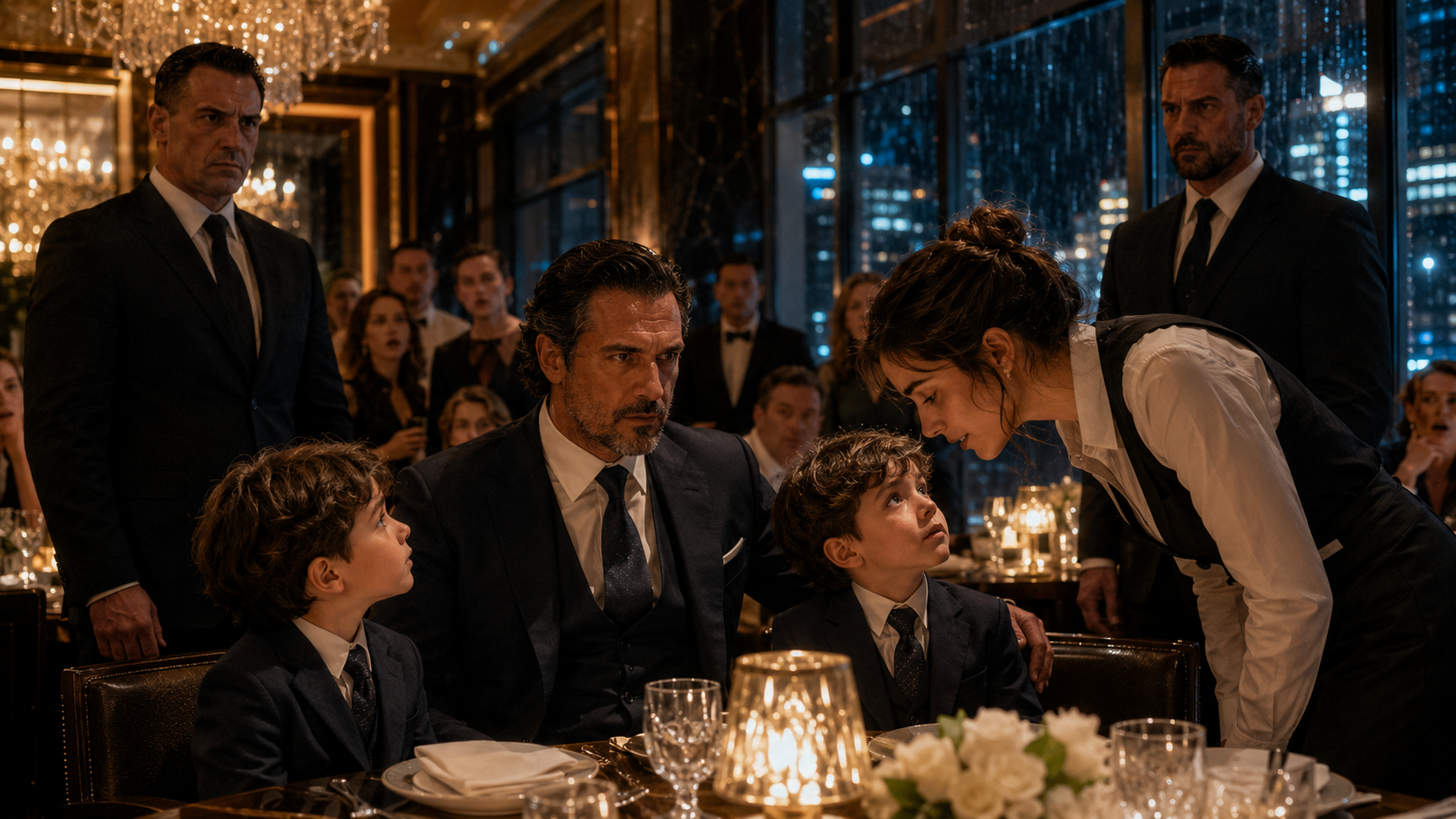
Marco De Luca was the kind of man people noticed before he even entered a room.
Conversations became quieter when his black car stopped outside a building.
Restaurant owners checked every table twice.
Politicians suddenly remembered other appointments.
Marco had built a powerful business empire across New York real estate, private security, international shipping, and luxury property investment.
Some people called him a businessman.
Others used darker names when they believed nobody was listening.
But none of Marco’s wealth, influence, or private banking connections could solve the only problem that truly mattered to him.
His six-year-old twin sons, Luca and Matteo, had never seen the world.
At least, that was what every medical report claimed.
The Diagnosis Money Could Not Change
The boys had been born during a complicated delivery.
Within days, doctors told Marco and his wife, Elena, that the twins had suffered severe visual impairment.
The specialists were careful with their language.
They discussed neurological damage, developmental delays, and limited treatment options.
Marco responded the only way he knew how.
He hired the best medical professionals money could find.
He flew specialists from Switzerland, Germany, Canada, and Japan to examine the twins.
He paid for advanced medical imaging, private rehabilitation programs, experimental consultations, and customized home care.
Every appointment ended with almost the same conclusion.
“The boys are unlikely to develop functional vision.”
Some doctors said it gently.
Others said it clinically.
One specialist looked directly at Marco and said, “You should prepare them for a life without sight.”
Marco accepted the diagnosis publicly.
Privately, he never stopped searching.
He converted an entire floor of his Manhattan townhouse into a learning center.
The twins received private education, occupational therapy, music lessons, and mobility training.
Their bedroom contained textured walls, carefully placed furniture, and an expensive audio-navigation system designed for visually impaired children.
Marco could purchase advanced technology.
He could arrange private healthcare.
He could fund university research.
But he could not make his sons look at him.
A Family Changed by Grief
Elena had been different after the twins were born.
She loved her sons deeply, but the guilt surrounding the delivery followed her everywhere.
Three years later, she died after a sudden illness.
Marco never discussed her death.
He simply became quieter.
Harder.
More protective.
The twins became the center of his private world.
Outside the house, Marco was feared.
Inside it, he personally checked whether Luca had eaten breakfast and whether Matteo had remembered his favorite wooden puzzle.
The boys rarely appeared in public.
Marco disliked strangers staring at them.
He disliked pity even more.
But on the night of their sixth birthday, Luca made an unusual request.
“I want to hear a restaurant,” he said.
Marco looked at him from across the breakfast table.
“You hear restaurants at home when the staff prepares dinner.”
Luca shook his head.
“No. A real one. With people.”
Matteo smiled.
“And plates. Lots of plates.”
Marco almost refused.
Then he remembered how many experiences the boys had already lost.
So he reserved a private section inside one of Manhattan’s most expensive restaurants.
The Rainy Night in Manhattan
Rain covered the city that evening.
Cars moved slowly through the wet streets while lights reflected across the pavement.
Marco arrived with the twins, two bodyguards, and their longtime caregiver, Mrs. Bennett.
The restaurant manager greeted them personally.
“Mr. De Luca, everything has been arranged.”
The dining room was elegant and quiet.
Crystal lights hung above polished tables.
Soft piano music played near the entrance.
The twins held Marco’s hands as they walked.
Luca counted their steps.
Matteo tilted his head toward the sound of silverware.
Their table had been positioned away from the main crowd, but people still watched them.
Marco noticed every glance.
He ignored them.
A young waitress named Sofia Bellini was assigned to a nearby section.
She was twenty-nine, with dark hair tied behind her head and a calm expression that rarely changed.
She had worked at the restaurant for eight months.
Most of the staff knew very little about her.
She arrived on time.
She worked hard.
She avoided personal questions.
That night, Sofia carried a tray past Marco’s table and suddenly stopped.
Matteo was tapping his spoon against a glass.
The sound was soft.
Tap.
Pause.
Tap.
Pause.
Each time the sound moved, Luca turned his head toward it.
Not toward the person holding the spoon.
Toward the reflection of the sound.
Sofia stared.
Then she quietly moved one step to the left.
She tapped her fingernail against the tray.
Both twins turned toward her.
The movement was immediate.
Precise.
The restaurant manager saw her standing there.
“Sofia,” he whispered sharply. “Keep moving.”
But she did not.
She tapped the tray again from a different position.
The twins turned together.
This time Marco noticed.
His expression changed.
“What are you doing?” he asked.
The bodyguards stepped forward.
Sofia placed the tray on an empty table.
“I need to ask you something.”
“You do not need to ask me anything.”
“Do they ever walk around furniture without touching it?”
Marco’s eyes narrowed.
Mrs. Bennett looked surprised.
“Sometimes,” she answered. “Especially at home.”
“Do they make clicking sounds with their tongues?” Sofia continued.
Matteo smiled.
“We do it when nobody is listening.”
Sofia slowly approached the table.
One of the bodyguards blocked her path.
Marco raised a hand.
The guard stepped aside.
Sofia knelt several feet away from the twins.
She clicked her tongue once.
Matteo turned toward a marble column.
Sofia clicked again.
Luca turned toward an open doorway.
Then she whispered four words.
“They see through sound.”
The Moment the Dining Room Went Silent
Marco did not move.
The restaurant seemed to disappear around him.
“What did you say?”
“They are using echolocation,” Sofia explained.
The word meant nothing to several people at the table.
But Mrs. Bennett’s face changed.
Sofia continued carefully.
“They make sounds and listen to the echoes. Their brains use those echoes to identify walls, doors, objects, and open spaces.”
Marco looked at his sons.
“That is impossible.”
“It is uncommon,” Sofia replied. “Not impossible.”
The manager hurried over.
“Mr. De Luca, I apologize. She should not be disturbing you.”
Marco did not look away from Sofia.
“How do you know this?”
She hesitated.
That hesitation immediately changed the mood.
The guards watched her more closely.
Marco’s voice became colder.
“How do you know what my doctors missed?”
Sofia looked at the twins.
“Because my younger brother did the same thing.”
The Brother Nobody Could Save
Sofia’s brother, Daniel, had lost his sight when he was four.
After an accident damaged his optic nerves, doctors told their family he would never move independently.
Daniel refused to accept that limitation.
He began making clicking sounds while walking through their apartment.
At first, the family thought it was a nervous habit.
Then Daniel started avoiding chairs without touching them.
He could identify an open door from several feet away.
He could tell whether a wall was made of brick, glass, or wood by listening to the returning sound.
Sofia’s mother contacted a neurological rehabilitation center in California.
The center specialized in sensory substitution and human echolocation training.
Daniel learned to navigate schools, sidewalks, and public buildings with remarkable independence.
“He was not seeing the way we see,” Sofia told Marco.
“But his brain was building a map.”
“What happened to him?” Luca asked softly.
Sofia’s voice became quieter.
“He became sick when he was seventeen.”
Marco studied her.
“And you worked at the rehabilitation center?”
“For four years. I assisted with mobility education and family training.”
“Then why are you serving food in a restaurant?”
The question was blunt.
Sofia did not appear offended.
“Because the center closed after losing funding. My professional certification did not transfer automatically to New York. I needed work while completing the required exams.”
Marco leaned back.
“You recognized this after watching them for less than a minute?”
“I recognized the pattern.”
She looked toward the twins again.
“They are not broken, Mr. De Luca.”
Nobody at the table spoke.
“They have adapted.”
A Test No Specialist Had Tried
Marco ordered the manager to close the private dining section.
Then he asked Sofia to demonstrate what she meant.
She requested three objects: a wooden chair, a metal serving cart, and a large empty box.
The staff placed them several feet apart.
Sofia asked Matteo to stand near the center of the room.
Marco immediately objected.
“He will fall.”
“I will stay close,” Sofia said.
Matteo clicked his tongue.
He turned toward the metal cart.
“Something hard is there.”
Sofia moved the cart.
Matteo clicked again.
“It moved.”
Marco’s hands tightened around the back of a chair.
Luca took his turn.
He identified the open space between the wooden chair and the box.
Then he walked through it slowly.
He did not touch either object.
Mrs. Bennett covered her mouth.
Marco stared at his son as if seeing him for the first time.
For six years, every expert had focused on what the boys could not do.
Sofia had noticed what they were already doing.
The Private Medical Review
By the next morning, Marco had arranged a complete neurological review.
He did not contact the same specialists who had examined the twins before.
Instead, he hired an independent medical advisory team with experience in pediatric neuroplasticity, sensory rehabilitation, and assistive technology.
Sofia was invited to attend.
She almost refused.
“This is not my position,” she said.
“It is now,” Marco replied.
The evaluation lasted three days.
The results did not reverse the original diagnosis.
The twins still had profound visual impairment.
But the doctors confirmed that both children had developed unusually strong auditory processing.
Brain scans showed increased activity in regions commonly associated with spatial awareness.
One neurologist explained that the boys’ brains appeared to be processing sound in a highly organized way.
“With structured training,” she said, “they may develop much greater independence than previously expected.”
Marco looked at Sofia.
She did not smile triumphantly.
She only asked the doctor about training frequency, safety procedures, and educational support.
That was when Marco realized she had not approached the twins to impress anyone.
She had approached them because she knew what it felt like for a child’s abilities to be ignored.
The Secret Inside Elena’s Files
A week later, Marco found Sofia’s name somewhere he never expected.
It appeared inside an old folder belonging to Elena.
The file contained medical correspondence from six years earlier.
One letter had been written by Sofia’s mother, Dr. Teresa Bellini.
Teresa had contacted Elena shortly after the twins’ diagnosis.
She had recommended an early sensory-development assessment.
The hospital had dismissed the suggestion.
The letter was never included in the official treatment plan.
Marco called Sofia to his office.
She stood across from his desk while rain struck the windows behind him.
“Your mother contacted my wife.”
Sofia went pale.
“You found the letter.”
“You knew?”
“I knew she had written to a family in New York. I did not know it was yours until I saw the twins.”
Marco placed the document on the desk.
“Why did your mother contact Elena?”
“Because she had read a medical summary about the twins through a research network. She believed their responses to sound should be studied.”
“And nobody listened.”
“No.”
Marco looked down at the letter.
The hospital had recommended against further consultation.
The reason was written in careful professional language.
The proposed assessment was considered unconventional and unlikely to change the prognosis.
Marco had spent millions on international treatment.
Yet the most important recommendation had been rejected before it reached him.
A Legal Dispute With the Hospital
Marco’s first instinct was anger.
He wanted names.
He wanted explanations.
He wanted the hospital administration held accountable.
But Sofia asked him to think carefully.
“Do not turn this into revenge,” she said.
His bodyguards looked shocked that anyone would speak to him that way.
Marco remained silent.
Sofia continued.
“Turn it into access.”
The hospital agreed to an independent investigation.
Its legal department reviewed the twins’ records, internal communication, and treatment decisions.
Marco’s attorneys discovered that several alternative rehabilitation recommendations had been excluded without proper family consultation.
The dispute ended with a confidential financial settlement.
But Marco refused to keep one condition private.
The hospital had to create a review policy requiring families to receive all credible rehabilitation options, even when those options did not promise a cure.
Part of the settlement funded a new pediatric sensory-development program.
Marco contributed additional money through his family foundation.
For the first time, his reputation opened a door for children who had no access to private healthcare or specialized insurance coverage.
Sofia’s New Position
Marco offered Sofia a position as director of family training at the new program.
She stared at the contract.
The salary was generous.
The healthcare benefits were excellent.
The program included funding for professional licensing, continuing education, and neurological research.
“I am not qualified to direct a hospital department,” she said.
“You are qualified to tell experts when they have stopped paying attention.”
“That is not the same thing.”
“No,” Marco replied. “It may be more important.”
Sofia accepted a temporary advisory role instead.
She wanted the position reviewed after completing her certification.
Marco respected the decision.
Over the following months, she trained Luca and Matteo several times each week.
They practiced identifying walls, trees, doorways, parked vehicles, and changes in floor texture.
The training was careful and gradual.
There were no miracles.
The boys did not suddenly gain normal sight.
They still used canes in unfamiliar places.
They still required support in crowded environments.
But they became more confident.
More independent.
More curious.
The Day Marco Finally Understood
One afternoon, Marco stood in the garden behind his townhouse.
Luca and Matteo were practicing with Sofia near a stone path.
Matteo clicked his tongue.
“There is a tree in front of me.”
“How far?” Sofia asked.
“Five steps.”
“Check.”
He moved forward carefully.
After four steps, he stopped and stretched out his hand.
His fingers touched the bark.
Matteo laughed.
Marco felt something inside him break open.
For years, he had measured hope by whether his sons would ever see his face.
He had never considered that they might experience him in another way.
That evening, Luca sat beside him in the library.
“Papa?”
“Yes?”
“I know when you are standing by the door.”
Marco looked at him.
“How?”
“Your shoes sound different.”
Luca smiled.
“And you breathe louder when you are worried.”
Marco lowered his head.
His son had been noticing him all along.
Not with his eyes.
With attention.
One Year Later
A year after the restaurant encounter, Luca and Matteo returned to the same dining room.
This time, there were no bodyguards standing directly behind their chairs.
Marco still kept security nearby, but he had learned to give the boys space.
They walked through the restaurant using their canes and soft tongue clicks.
Several guests watched.
Marco no longer cared.
Sofia joined them at the table wearing a navy jacket with the logo of the Bellini Center for Sensory Development.
The center had opened three months earlier.
It provided affordable rehabilitation, family counseling, assistive technology, and educational planning for visually impaired children.
Insurance companies had begun covering some of its services.
A major healthcare foundation funded the rest.
The restaurant manager brought a small cake.
Luca tapped his spoon against the plate.
Matteo turned toward him instantly.
Everyone laughed.
Marco looked at Sofia.
“You changed their lives.”
She shook her head.
“No. They were already changing their own lives.”
She looked toward the twins.
“I only recognized the language they were using.”
Marco considered the words.
Then he raised his glass.
“To being understood.”
The twins raised their glasses of sparkling water.
“To sound,” Matteo added.
The Truth Nobody Expected
Marco De Luca had spent years believing power meant controlling every risk.
He believed money could purchase the best medical treatment, the strongest legal protection, and the safest future.
But the most important discovery of his life came from a waitress who had nothing to gain by approaching his table.
She did not offer a miracle.
She offered attention.
She noticed an ability hidden beneath a diagnosis.
She saw two children the world had already defined by their limitations.
And because she refused to remain silent, Luca and Matteo were finally given the opportunity to build a life around what they could do.
The boys were still blind.
But they were no longer living in complete darkness.
They had learned to navigate the world through sound.
Marco had learned something too.
Sometimes the person who changes your life is not the most powerful expert in the room.
Sometimes it is the one person willing to look closer when everyone else has stopped searching.