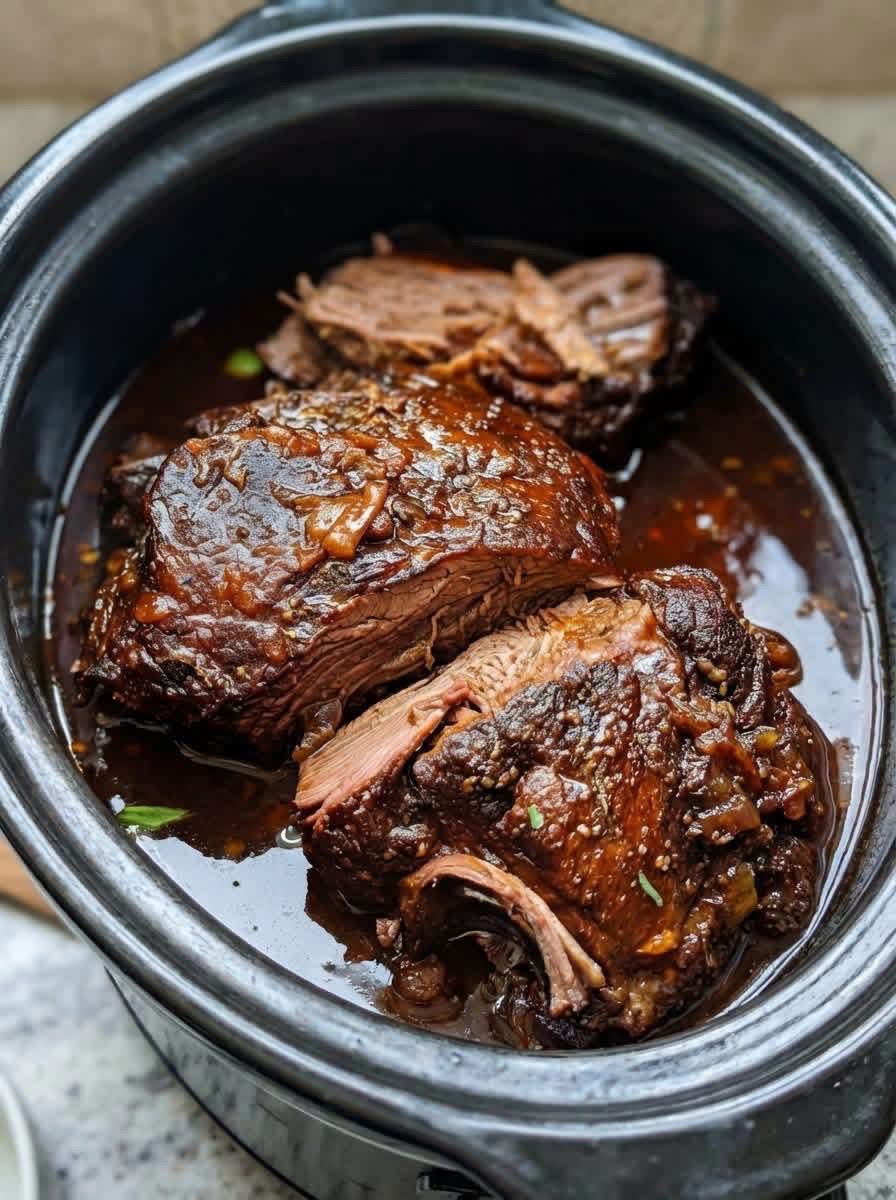
Slow Cooker Pot Roast with Rich Onion Gravy is a comforting family dinner made with tender beef, softened onions, garlic, herbs, and a deeply flavored brown sauce.
A well-marbled chuck roast cooks gently for several hours until the meat becomes soft enough to separate with a fork. During the long cooking time, the beef releases rich juices that combine with the broth, onions, Worcestershire sauce, and seasonings to create a savory homemade gravy.
The finished roast has a dark caramelized exterior, a moist center, and enough sauce to serve over mashed potatoes, rice, egg noodles, or creamy polenta.
This easy slow cooker beef recipe is perfect for Sunday dinners, busy weekdays, cold evenings, holiday meals, meal preparation, and family gatherings. Most of the work is completed at the beginning, allowing the slow cooker to handle the long and gentle cooking process.
Why This Recipe Is Popular
Slow cooker pot roast remains a favorite because it transforms an affordable cut of beef into a tender and satisfying meal.
Chuck roast contains fat and connective tissue that soften during long cooking. Instead of becoming dry, the meat absorbs the seasoned broth and gradually develops a rich texture.
The recipe is also flexible. Potatoes, carrots, mushrooms, celery, red wine, or different herbs can be added according to your family’s preferences.
The cooking liquid becomes a natural base for gravy, so you do not need to prepare a completely separate sauce.
Leftovers taste delicious the following day and can be used inside sandwiches, pasta, rice bowls, tacos, or soups.
Recipe Information
The preparation time is approximately twenty-five minutes.
The roast cooks for approximately eight to nine hours on Low or five to six hours on High.
Allow approximately fifteen minutes for resting and thickening the gravy.
The complete recipe provides about six to eight servings, depending on the size of the roast and the portions served.
Main Ingredients
Chuck roast provides the best balance of beef flavor, marbling, and tenderness for this recipe.
Yellow onions soften slowly and add natural sweetness to the gravy.
Garlic gives the sauce a warm and savory aroma.
Beef broth creates the liquid base, while Worcestershire sauce adds depth and a slightly tangy flavor.
Tomato paste strengthens the color and gives the gravy a richer taste without turning it into tomato sauce.
Thyme, rosemary, paprika, onion powder, salt, and black pepper season the meat throughout the long cooking process.
Cornstarch can be added near the end when you want a thicker gravy.
Ingredients
You will need one boneless chuck roast weighing approximately three and a half to four pounds.
For seasoning, use one and a half teaspoons of salt, one teaspoon of black pepper, one teaspoon of garlic powder, one teaspoon of onion powder, one teaspoon of smoked or sweet paprika, one teaspoon of dried thyme, and half a teaspoon of dried rosemary.
For browning, use two tablespoons of neutral oil.
For the gravy, use two large yellow onions sliced or chopped, five minced garlic cloves, two cups of low-sodium beef broth, two tablespoons of Worcestershire sauce, two tablespoons of tomato paste, and one tablespoon of soy sauce.
To thicken the gravy, use three tablespoons of cornstarch mixed with three tablespoons of cold water.
Fresh parsley may be added shortly before serving.
The Best Cut of Beef to Use
Chuck roast is the most reliable choice for slow cooker pot roast.
It contains enough marbling and connective tissue to become tender during a long cooking time. The fat melts gradually and helps keep the meat moist.
Brisket can also be used, although it has a slightly different texture and is best sliced across the grain.
Bottom round or rump roast is leaner. These cuts may still work, but they can become firmer or drier when overcooked.
Avoid extremely lean beef when you want the soft, pull-apart texture shown in the image.
Choose a roast with visible marbling rather than one large section of hard exterior fat.
Should You Brown the Roast First?
Browning the roast is optional, but it improves the final flavor and appearance.
High heat creates a dark crust on the outside of the beef. This browned surface adds deeper flavor to both the meat and the gravy.
The skillet also develops small browned pieces that can be dissolved with broth and added to the slow cooker.
When you are short on time, the seasoned roast can be placed directly into the cooker. It will still become tender, although the finished sauce may have a lighter flavor and color.
Prepare the Roast
Remove the roast from its packaging and pat it dry with paper towels.
Drying the surface helps the seasoning stick and allows the beef to brown instead of steam.
Trim only unusually thick pieces of hard exterior fat.
Leave the smaller lines of marbling because they help the roast remain moist during cooking.
Combine the salt, black pepper, garlic powder, onion powder, paprika, thyme, and rosemary.
Rub the seasoning mixture over every side of the beef.
Allow the seasoned roast to rest for approximately ten minutes while the skillet heats.
Brown the Roast
Heat the oil inside a large heavy skillet over medium-high heat.
Place the roast inside the hot pan.
Allow it to cook without moving for approximately three to four minutes.
Turn it carefully and brown the remaining sides.
The beef does not need to cook through.
The goal is to create a dark golden crust.
Transfer the browned roast to a clean plate while preparing the slow cooker.
Prepare the Onions
Peel the onions and cut them into thick slices or medium pieces.
Spread them across the bottom of a six-quart slow cooker.
The onions create a flavorful base and lift the roast slightly above the direct heat of the insert.
During cooking, they soften and blend into the gravy.
For a smoother sauce, chop them finely.
For visible onion pieces, use thicker slices.
Add the Garlic
Sprinkle the minced garlic over the onions.
Fresh garlic provides the strongest flavor, but garlic powder may be used when fresh cloves are unavailable.
Avoid placing all the garlic directly against the bottom of the hot slow cooker because it may become bitter near the edges.
Distributing it over the onions protects it and allows the flavor to spread gradually.
Deglaze the Skillet
Reduce the skillet heat to medium.
Add approximately half a cup of beef broth.
Use a wooden spoon to scrape the browned pieces from the bottom.
Stir in the tomato paste and continue cooking for approximately one minute.
Add the Worcestershire sauce and soy sauce.
Stir until the mixture becomes smooth.
Pour this flavorful liquid over the onions inside the slow cooker.
Assemble the Slow Cooker
Place the browned chuck roast over the onions and garlic.
Pour the remaining beef broth around the roast.
The liquid does not need to cover the meat completely.
The beef and onions will release additional moisture during cooking.
Spoon a small amount of the sauce over the top of the roast.
Cover the slow cooker securely with its lid.
Cook the Pot Roast on Low
Cook the roast on Low for approximately eight to nine hours.
The Low setting usually creates the most tender and consistent result.
Avoid opening the lid repeatedly because each opening releases heat and steam.
Begin checking the meat near the eight-hour mark.
The roast should separate easily when pressed with a fork.
When it still feels firm, replace the lid and continue cooking for another thirty to sixty minutes.
Cook the Pot Roast on High
When less time is available, cook the roast on High for approximately five to six hours.
The beef can still become tender, but the Low setting is generally more forgiving.
Begin checking the roast near the five-hour mark.
Cooking time varies according to the thickness of the meat and the temperature of the slow cooker.
A thicker roast may need additional time even when its weight is similar.
How to Know When the Roast Is Ready
The meat should feel very tender when pierced with a fork.
You should be able to pull a small section away without using significant force.
Chuck roast often becomes shreddable when its internal temperature reaches approximately 195°F to 205°F, although tenderness is more important than one exact number.
If the beef is safely cooked but still chewy, it usually needs additional time for the connective tissue to soften.
Remove and Rest the Roast
Transfer the cooked roast carefully to a large serving platter or cutting board.
Cover it loosely with foil.
Allow it to rest for approximately fifteen minutes.
Resting helps the juices settle and makes the meat easier to slice or pull apart.
Do not discard the liquid inside the slow cooker.
It will become the rich onion gravy served with the beef.
Remove Excess Fat From the Gravy
After several minutes, some fat may rise to the surface of the cooking liquid.
Use a large spoon to remove the excess.
Leave a small amount because it carries flavor and gives the gravy richness.
When time allows, the liquid can be poured into a fat separator.
Return the broth and onions to the slow cooker after removing the unwanted fat.
How to Thicken the Onion Gravy
Combine the cornstarch and cold water inside a small bowl.
Stir until completely smooth.
Turn the slow cooker to High.
Pour the cornstarch mixture slowly into the hot cooking liquid while stirring.
Cover and cook for approximately ten to fifteen minutes.
The sauce will gradually become thicker and glossier.
When you prefer a very thick gravy, prepare a second smaller cornstarch mixture rather than adding dry powder directly.
Blend the Gravy When Desired
For a smoother onion gravy, use an immersion blender to blend part or all of the onions into the sauce.
Move the cooking liquid to a safe deep container when necessary.
Blend carefully because the sauce is hot.
For a rustic gravy, leave the softened onion pieces whole.
Both versions have the same rich flavor.
Taste and Adjust the Seasoning
Taste the gravy before serving.
Add salt only when necessary because the broth, soy sauce, and Worcestershire sauce already contain sodium.
A small amount of black pepper, garlic powder, or Worcestershire sauce may be added when the flavor needs more depth.
When the gravy tastes too rich, add one teaspoon of red wine vinegar or lemon juice.
The acidity brightens the sauce without making it taste sour.
Slice or Shred the Beef
Use a sharp knife to cut the roast across the grain.
Cutting across the grain creates shorter muscle fibers and produces more tender slices.
For shredded beef, use two forks to separate the meat into large pieces.
Remove any large sections of softened fat while shredding.
Return some of the meat to the gravy when you want every piece heavily coated.
Simple Recipe Overview
Season and brown the chuck roast.
Place onions and garlic inside the slow cooker.
Prepare a sauce using beef broth, tomato paste, Worcestershire sauce, and soy sauce.
Place the roast over the onions and pour in the sauce.
Cook until the beef becomes fork-tender.
Remove and rest the roast.
Skim excess fat and thicken the cooking liquid.
Slice or shred the beef and serve it with the rich onion gravy.
Tips for the Best Slow Cooker Pot Roast
Use a well-marbled chuck roast rather than an extremely lean cut.
Pat the beef dry before seasoning and browning.
Brown every side when time allows.
Use low-sodium broth so the sauce does not become too salty.
Cook on Low for the most tender result.
Keep the lid closed during most of the cooking time.
Continue cooking when the meat remains chewy.
Rest the roast before slicing.
Thicken the gravy only after the meat has finished cooking.
Pot Roast With Carrots and Potatoes
Carrots and potatoes can be added to create a complete meal inside one slow cooker.
Use thick carrot pieces and small Yukon Gold or red potatoes.
Place the vegetables around or beneath the roast.
Avoid cutting them too small because they may become overly soft before the beef is tender.
Waxy potatoes hold their shape better than Russet potatoes during long cooking.
Add delicate vegetables only during the final hours when you prefer a firmer texture.
Mushroom Pot Roast
Mushrooms add an earthy flavor that pairs beautifully with the dark onion gravy.
Use approximately twelve ounces of sliced cremini or white mushrooms.
For a deeper flavor, brown them inside the skillet after searing the roast.
Add them to the slow cooker during the final two to three hours.
When added at the beginning, they will become very soft and blend more completely into the sauce.
Red Wine Pot Roast
Replace one cup of beef broth with dry red wine.
After browning the roast, add the wine to the skillet and scrape the browned pieces from the bottom.
Allow it to simmer for several minutes before pouring it into the slow cooker.
Red wine creates a deeper and more complex gravy.
Use a wine that tastes pleasant rather than a heavily salted cooking wine.
French Onion Pot Roast
Increase the onions to three or four large onions.
Slice them thinly and brown them slowly with butter before placing them inside the slow cooker.
Add thyme, Worcestershire sauce, and a small amount of garlic.
The finished gravy will have a sweeter and stronger onion flavor.
Serve the roast with mashed potatoes and melted provolone or Swiss cheese when desired.
Garlic Butter Pot Roast
Increase the fresh garlic to eight cloves.
After the roast has finished cooking, melt three tablespoons of butter with chopped parsley and a small amount of garlic powder.
Stir part of the garlic butter into the gravy.
Brush the remaining butter lightly over the sliced meat.
This variation creates an especially rich and aromatic dinner.
Balsamic Pot Roast
Add one-quarter cup of balsamic vinegar to the sauce.
Reduce the Worcestershire sauce slightly.
The vinegar adds sweetness and acidity that balance the rich beef.
A small amount of brown sugar or honey may be included when the vinegar tastes very sharp.
Balsamic pot roast pairs well with mashed potatoes, roasted carrots, and green beans.
Barbecue Pot Roast
Replace the tomato paste with approximately one cup of thick barbecue sauce.
Reduce the soy sauce and Worcestershire sauce slightly.
The resulting beef will be smoky, sweet, and suitable for sandwiches.
After cooking, shred the meat and mix it with enough sauce to remain moist.
Serve it inside toasted rolls with coleslaw or pickles.
Spicy Pot Roast
Add crushed red pepper flakes, cayenne pepper, chipotle powder, hot sauce, or sliced jalapeño to the cooking liquid.
Begin with a small amount because spices become stronger during long cooking.
Smoked paprika adds warmth without strong heat.
Serve spicy pot roast with cooling sour cream, rice, or creamy mashed potatoes.
Creamy Pot Roast Gravy
After thickening the gravy, reduce the slow cooker to Low.
Stir in half a cup of heavy cream.
For sour cream, place it inside a bowl and mix it with several spoonfuls of warm gravy before adding it to the cooker.
This prevents sudden temperature changes that may cause separation.
Avoid boiling the sauce strongly after adding dairy.
What to Serve With Pot Roast
Slow Cooker Pot Roast pairs especially well with mashed potatoes because they absorb the rich onion gravy.
It can also be served with white rice, brown rice, buttered egg noodles, polenta, roasted potatoes, or cauliflower mash.
Green beans, roasted carrots, broccoli, peas, corn, Brussels sprouts, and garden salad are excellent vegetable choices.
Warm dinner rolls, biscuits, or crusty bread can be used for collecting the remaining sauce from the plate.
How to Serve Pot Roast Over Mashed Potatoes
Prepare smooth mashed potatoes with butter, warm milk, salt, and black pepper.
Place a generous spoonful on each plate.
Add slices or large pieces of pot roast.
Spoon the onion gravy over the meat and part of the potatoes.
Finish with chopped parsley and freshly ground black pepper.
Serve immediately while the gravy is hot.
Pot Roast Sandwiches
Shred the leftover beef and mix it with enough gravy to keep it moist.
Place the meat inside toasted sandwich rolls, brioche buns, or hoagie bread.
Add provolone cheese, caramelized onions, pickles, or horseradish sauce.
For melted cheese, place the sandwiches beneath the broiler briefly.
Serve them with fries, soup, salad, or roasted vegetables.
Pot Roast Rice Bowls
Place cooked rice inside serving bowls.
Add shredded beef and onion gravy.
Complete the bowls with roasted carrots, broccoli, green beans, or sautéed mushrooms.
Rice bowls are convenient for weekly meal preparation.
Keep the gravy over the beef so the meat remains moist during storage and reheating.
Pot Roast Tacos
Shred the cooked beef into smaller pieces.
Warm corn or flour tortillas.
Add the beef, chopped onion, cilantro, shredded cheese, and a small amount of gravy.
Salsa, avocado, pickled onions, or lime juice may also be added.
Avoid adding too much liquid so the tortillas remain easy to hold.
Pot Roast Pasta
Chop or shred the leftover beef.
Warm it with part of the onion gravy.
Toss it with cooked egg noodles, rigatoni, or pappardelle.
Add mushrooms or spinach when desired.
A small amount of Parmesan can be sprinkled over the top.
This variation transforms leftovers into a completely different dinner.
Meal-Prep Instructions
Allow the roast and gravy to cool slightly.
Divide them between airtight meal-prep containers.
Add mashed potatoes, rice, noodles, or vegetables.
Keep the beef covered with gravy to prevent it from drying out.
Refrigerate for up to four days.
Reheat only the portion you plan to eat.
Add a small amount of broth when the gravy becomes too thick during storage.
How to Store Leftovers
Transfer the cooled beef and gravy to an airtight container.
Refrigerate for up to four days.
Do not leave cooked beef at room temperature for longer than two hours.
During warm weather, refrigerate it sooner.
Store the meat inside the gravy whenever possible.
The sauce protects the beef and helps it remain moist.
Discard leftovers that develop an unusual smell, appearance, or texture.
How to Reheat Pot Roast
Place the beef and gravy inside a covered saucepan or skillet.
Warm over medium-low heat.
Add a small splash of beef broth or water when the sauce is very thick.
Turn the beef occasionally until the center is hot.
For oven reheating, place the meat and gravy inside a covered baking dish and warm at 325°F.
Microwave individual portions in short intervals and stir the gravy between each interval.
Can You Freeze Pot Roast?
Yes.
Pot roast freezes very well.
Allow the beef and gravy to cool completely.
Place them inside a freezer-safe container or storage bag.
Remove as much air as possible.
Freeze for up to three months.
Thaw overnight inside the refrigerator.
Reheat gently with a small amount of broth when necessary.
Freeze the beef inside the gravy for the best texture.
Freezer-Meal Preparation
Place the raw seasoned roast, onions, garlic, tomato paste, Worcestershire sauce, soy sauce, herbs, and broth inside a large freezer-safe bag.
Seal and freeze immediately.
Thaw the complete bag overnight inside the refrigerator.
Do not place a frozen roast directly into the slow cooker.
Transfer the thawed ingredients to the cooker and follow the original instructions.
Brown the roast before freezing when you want the deeper seared flavor.
Make-Ahead Instructions
The roast can be seasoned one day before cooking.
Store it covered inside the refrigerator.
The onions and garlic can also be prepared ahead.
Mix the sauce ingredients inside a covered container.
When ready to cook, brown the beef, assemble the slow cooker, and begin cooking.
The complete pot roast can also be prepared one day before serving.
Refrigerate it in the gravy and reheat gently the following day.
Why Is My Pot Roast Tough?
The roast may need additional cooking time.
Chuck roast can remain firm until the connective tissue has fully softened.
Replace the lid and continue cooking for another thirty to sixty minutes.
The meat may also be tough when an extremely lean cut is used.
A well-marbled chuck roast is more reliable for a soft texture.
Why Is My Pot Roast Dry?
The beef may have cooked for too long after becoming tender.
The cut may also have been too lean.
Keep the roast inside or covered with gravy during serving and storage.
Add warm broth when reheating.
Chicken breasts and lean beef cuts dry more quickly than chuck roast during long cooking.
Why Is My Gravy Too Thin?
Beef and onions release liquid while cooking.
Remove the roast and turn the cooker to High.
Add the cornstarch mixture and cook until the gravy thickens.
You can also leave the lid open briefly to allow moisture to evaporate.
The sauce will become slightly thicker as it cools.
Why Is My Gravy Too Thick?
Add warm beef broth or water one tablespoon at a time.
Stir gently after each addition.
Do not pour in a large amount at once.
Gravy often thickens further after refrigeration, so leftovers may need additional liquid while reheating.
Why Is the Gravy Too Salty?
Beef broth, soy sauce, Worcestershire sauce, and some seasoning blends contain sodium.
Use low-sodium broth and avoid adding too much salt at the beginning.
Add unsalted broth or water when the gravy is too salty.
Serving it with plain potatoes, rice, or noodles can also balance the flavor.
Why Does the Gravy Taste Flat?
Add another small amount of Worcestershire sauce, black pepper, garlic powder, or tomato paste.
A teaspoon of vinegar or lemon juice can brighten the flavor.
Fresh parsley adds color and freshness.
Adjust the seasoning gradually and taste after every addition.
Can I Use Frozen Beef?
Thaw the roast completely inside the refrigerator before placing it in the slow cooker.
Frozen meat may remain at an unsafe temperature for too long while the appliance heats.
Never thaw raw beef on the kitchen counter.
A large roast may require one or two days to thaw fully inside the refrigerator.
Can I Skip Browning?
Yes.
Season the roast and place it directly over the onions.
Pour the sauce around it and cook according to the original instructions.
The meat will still become tender.
Browning mainly improves the color and creates a deeper flavor.
Can I Cook Vegetables With the Roast?
Yes.
Use thick pieces of potatoes, carrots, mushrooms, celery, or parsnips.
Place firm vegetables near the bottom of the cooker.
Add softer vegetables later when you prefer them to hold their shape.
Avoid filling the cooker beyond approximately three-quarters of its capacity.
Can I Double the Recipe?
Use two separate slow cookers when preparing two large roasts.
Overcrowding one cooker can lead to uneven cooking.
Prepare a double quantity of sauce, but add salt gradually.
Check each roast separately because one may become tender sooner than the other.
Can I Make This Recipe in the Oven?
Yes.
Place the browned roast, onions, garlic, and sauce inside a covered Dutch oven.
Bake at 325°F for approximately three to four hours.
Check the meat near the early end of the range.
Continue cooking until it becomes fork-tender.
Remove the roast and thicken the gravy on the stovetop when necessary.
Final Thoughts
Slow Cooker Pot Roast with Rich Onion Gravy is a classic comfort-food dinner made with tender chuck roast, onions, garlic, beef broth, herbs, and a deeply flavored brown sauce.
The slow cooker gently softens the meat and allows it to absorb the savory cooking liquid.
For the best result, choose a well-marbled chuck roast, season it generously, and brown every side before slow cooking.
Cook on Low until the meat becomes fork-tender.
Allow the roast to rest, then thicken the onion gravy and serve it over the beef.
Pair the roast with mashed potatoes, rice, noodles, vegetables, or warm bread.
Customize it with carrots, potatoes, mushrooms, red wine, balsamic vinegar, garlic butter, or gentle heat.
This dependable slow cooker dinner is perfect for family meals, Sunday suppers, holidays, meal preparation, and cold evenings when you want warm homemade comfort food.